





















8 digital trends for restaurants to watch
10 January 2022
Which digital trends are really worth it for restaurateurs?
Which are the ones that last, that meet real needs on the customer side, but also the day-to-day constraints of our teams?
Whether you manage a traditional restauranta fast-food establishmenta food courta bar or a karaokeDigital is no longer limited to the in-theater experience. It now structures the customer journey ORDER FORMpayment loyalty and a growing part of the internal organization.
Here are 8 digital solutions that are now firmly established in industry practice, and that you should adopt right away.
01. Contactless ordering and payment, the new standard
At toll booths, on public transport, in stores, in restaurants... the telephone has replaced the card, and sometimes even the wallet.
This figure illustrates a profound change in payment habits. Contactless has become an integral part of everyday life, far beyond one-off situations.
In the foodservice sector, this expectation translates into faster, more direct customer paths. View menu, order and set without waiting is now standard, both in the dining room and at the counter.
Focus on Obypay's Tap to Pay terminal
To adapt to these new uses, some solutions now integrate payment directly at the point of order.
Visit Tap to Pay terminal Obypay allows customers to order and pay using contactless technology, directly from the terminal, without having to go to the cash desk.
Payment takes place in the same place as the order, with no additional terminals for restaurateurs to manage.
Discover Obypay's Tap to Pay kiosk ➜ Tap to Pay kiosk: the new standard for restaurant checkouts in 2026

02. Self-service ordering wins over more and more restaurateurs
Self-service ordering is on the rise in many establishments of all sizes.
ordering kiosk, QR Code menu or table ordering by telephone The customer orders on his own, when he's ready, without depending on the pace of the service.
Self-service ordering allows you to :
➜ absorb traffic peaks without waiting at the counter
➜ avoid choppy or interrupted order taking
➜ reduce errors related to options, extras or customer preferences
➜ let the customer take the time to choose, without pressure
Another point sometimes underestimated: self-service standardizes order-taking.
The route is the same for everyone, which simplifies organization, especially in the high-volume establishments or with team turnover.
For restaurateurs, it's not a question of replacing teams, but of distributing roles more effectively. Teams concentrate on preparation and dispatch, while orders are placed autonomously.
03. Click & Collect and delivery, the winning duo
In France today, 33 % of consumers say they have used Click & CollectThis is a sign that this channel is taking root in purchasing habits. And nearly one consumer in two has had a meal delivered to their homeThe adoption rate is even higher among young people (up to 8 out of 10 in the 18-24 age group).
These two channels are now as much a part of the customer experience as on-site consumption. For many customers, the choice is no longer made solely on the menu, but also on the possibility of ordering takeaway or delivery.
Visit Click & Collect meets a need for practicality. Customers order when they like, and pick up their order at the time they choose, avoiding the need to wait in line.
Visit deliveryis part of a well-established pattern of use, particularly in the evenings, at weekends or when you're under pressure.
For restaurateurs, these channels do not replace the dining room, but complement it. They enable us to capture orders outside peak hours and extend our catchment area, without relying solely on physical flows.
04. Digitization behind the stove too
In many plants, paper vouchers are gradually giving way to production screens.
This changes the way the service is managed on a day-to-day basis:
➜ commands are displayed in real time, with no risk of loss or misreading
➜ priorities are clearer, especially when several channels are operating at the same time
➜ teams gain visibility on future flows
The kitchen is thus better connected to the rest of the facility. Teams know what's coming, in what order, and can better organize themselves, even when several order channels coexist (on site.) Grab & Go, Click & Collect, Click & Deliveryetc.).
When order-taking is digitalized, production must be too, to avoid breaks in the flow.
05. Customer loyalty at the heart of restaurants' digital strategies
If you had to choose just one piece of advice to keep in mind, it would be this: build loyalty!
In a context where customers are spoilt for choice, getting those who already know the establishment to come back becomes a central issue.
Attracting new customers is obviously important, but it's repeat business that keeps an establishment running over the long term. A repeat customer costs less to activate, orders more easily and is already familiar with your business.
That's why loyalty is playing an increasingly important role in restaurants' digital strategies.
Today's digital tools make it possible to centralize all orders from a single customer, whatever the channel: on-site, takeaway or delivery. A useful way to better understand consumer habits, without having to multiply exports or paper maps.
Focus on Obypay's loyalty program
The Obypay loyalty program is based on a centralized customer databaseconnected to all the control paths.
This database allows you to segment customers according to their habits frequency of visit, average amount, products ordered or channel used.
This approach paves the way for more targeted communications:
➜ send a personalized birthday offer
➜ highlight a product that is regularly ordered
➜ encourage a customer to return after a period of inactivity
The program can operate on a cashback or points basis, depending on the establishment's strategy and the type of clientele. This flexibility allows us to adapt our fidelity to the reality on the ground, rather than the other way round.

06. Connecting with customers, even when not in service
Building customer loyalty also means staying present between visits.
Once the customer relationship has been structured via a loyalty program and a database, how can you continue to exchange with your customers, without waiting for them to come back on their own?
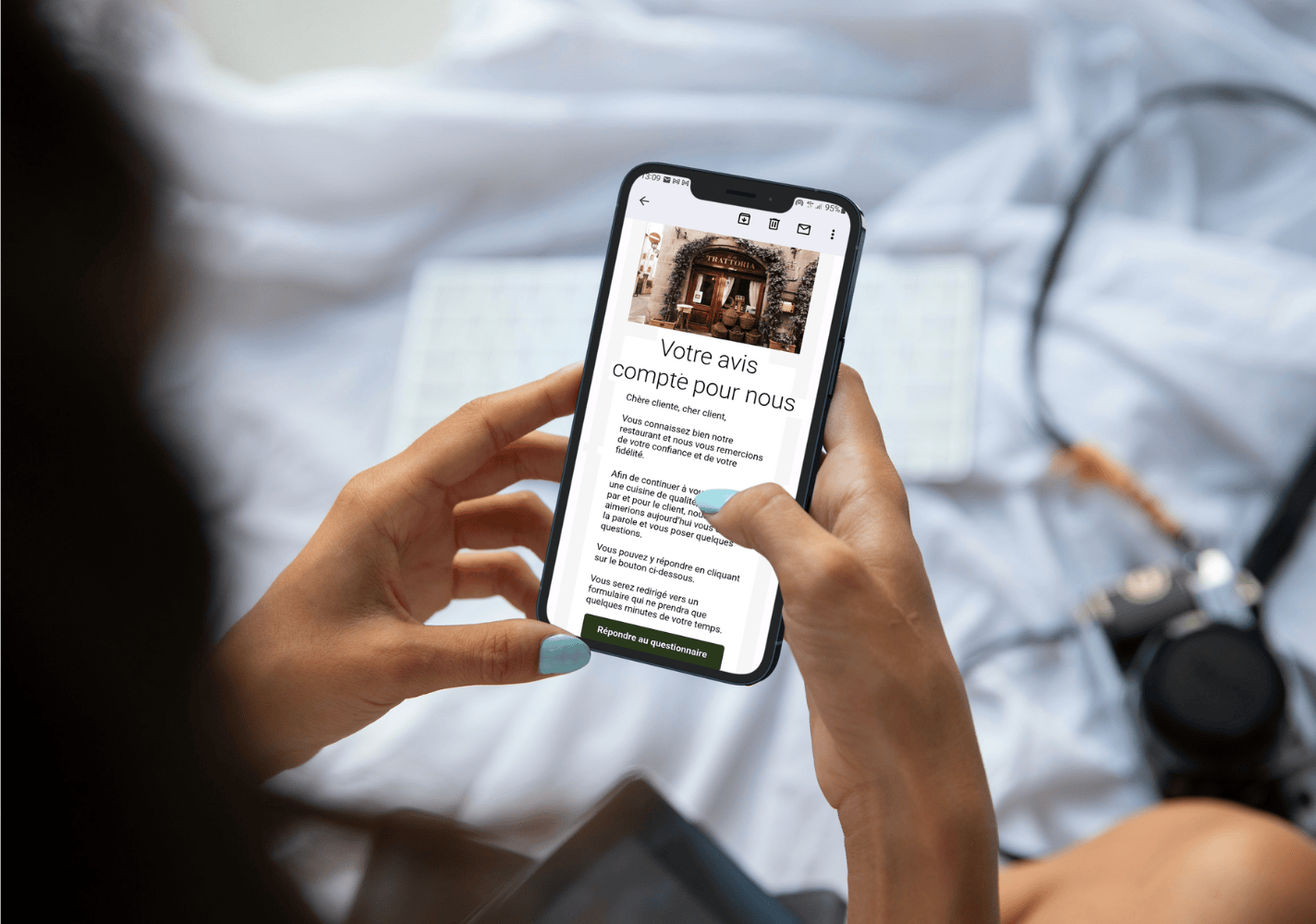
Digital communication is precisely the way to extend the link out of service. Emails, SMS or notifications allow you to remain visible, without relying solely on social networks or theatrical appearances.
Unlike social platformsThese channels rely on a qualified contact base. Messages arrive directly to the customer's phone or mailbox, at the chosen time, depending on the topic of the moment:
➜ inform about an à la carte novelty
➜ announce a special event or offer
A good way to encourage people to return to their homes, without undue commercial pressure.
07. Reinventing ourselves to combat labor shortages
Labour shortages are an enduring reality for many establishments. Faced with this situation, many restaurateurs are rethinking their organization rather than trying at all costs to operate "as before".
Digital tools play a key role here. Self-service ordering, payment at the table, order terminals or kitchen screens enable tasks to be distributed more evenly, and relieve teams at the busiest times of the day.
In high-volume establishments such as fast foodthe food courts or the multi-site networks, these tools also help to maintain a constant level of service, even with a reduced workforce.
Reinventing ourselves therefore requires less radical transformation than targeted adjustments, designed for the realities of everyday life.
08. Automate inventory management to avoid costly errors
Inventory management remains one of the most sensitive areas in foodservice. Too many out-of-stocks disrupt service, while too many overstocks generate losses.
Keeping track of stock levels by hand quickly becomes complex, especially when several ordering channels coexist: on-site, takeaway, delivery, self-service.
L'automation makes it easier to link sales to stock realities. Each order placed updates the quantities available, making it easier to anticipate replenishments and limit discrepancies at the end of the service.
This type of tool makes it possible to :
➜ reduce food waste
➜ avoid unexpected breaks in service
➜ better manage purchasing and supplier orders
For restaurateurs, the stakes are not just financial. More reliable stock management also means greater peace of mind on a day-to-day basis, especially during busy periods.
Automation doesn't mean delegating everything with your eyes closed, but rather having clear indicators to help you make better decisions, without spending too much time on it.
Catering in tune with changing customer needs
Today, Obypay helps more than 2,000 restaurateurs to set up digital paths adapted to their needs and constraints.
Do you have a project or questions about your order, payment or loyalty processes? Our team is available to discuss your requirements.